Andreas Schaerer
Andreas Schaerer
Andreas Schaerer – vocals
Luciano Biondini – accordion
Kalle Kalima – guitar
Lucas Niggli – drums
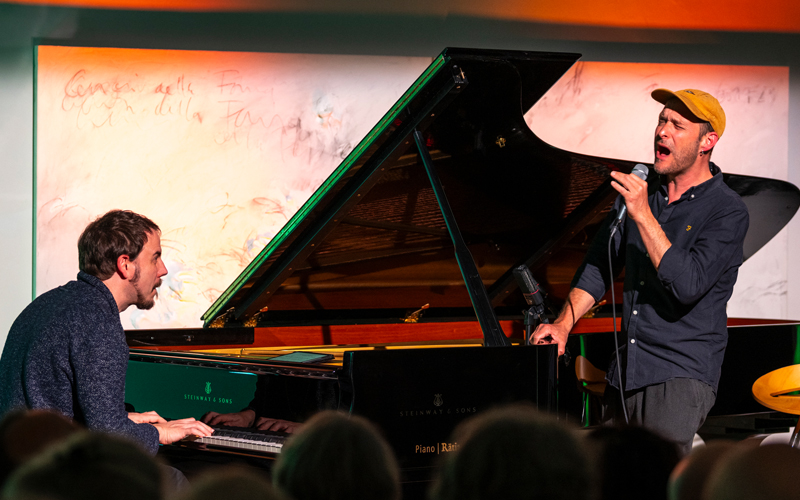
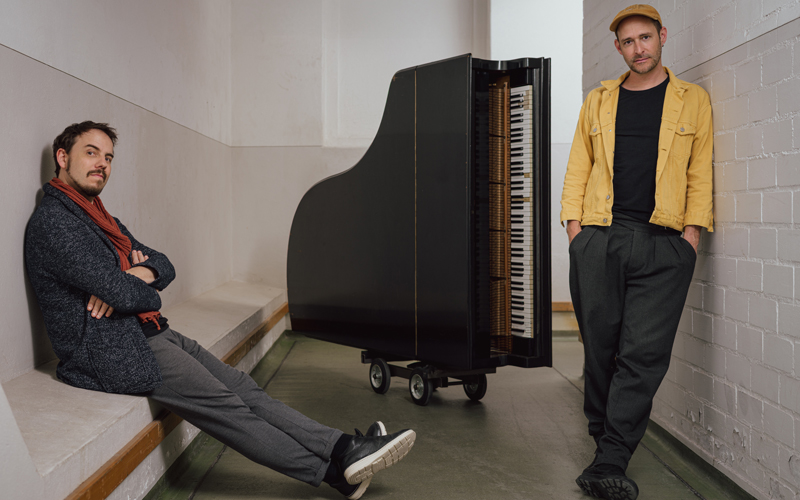
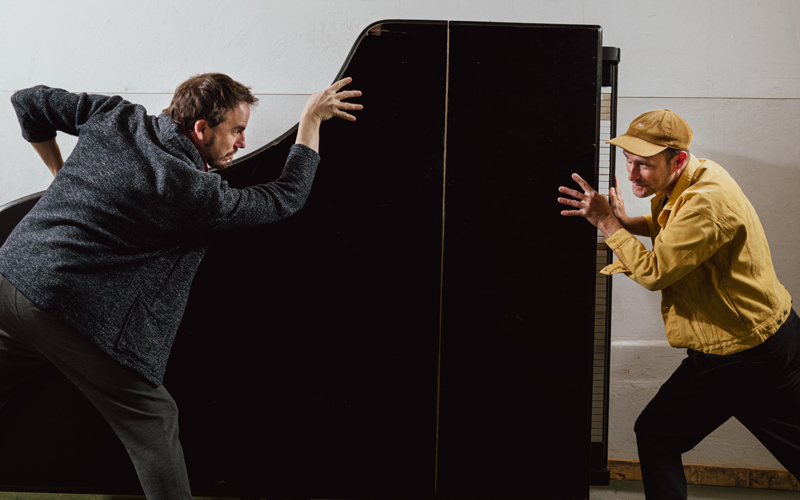
Andreas Schaerer (voc) &
Daniel Garcia Diego (p) Duo
SCHAERER – BIONDINI – KALIMA – NIGGLI
A Novel Of Anomaly ( CH, IT, FIN)
Andreas Schaerer vocals
Luciano Biondini accordion
Kalle Kalima guitar
Lucas Niggli drums
A Finn, an Italian and two Swiss bring good vibes, joy and the finest listening pleasure into your home. Not only does each musician have their own signature style, but they are also stylistically at home in their own domain, so to speak. Between jazz and world music, eclecticism and avant-garde, the four gentlemen play their way into their audience’s ears with ease. Sparkling, fresh, new and yet somehow familiar.
Nothing about this quartet is normal. But that’s exactly why it surprises – and why it works. Because when a Finn and an Italian strike up a conversation, translated as it were by two Swiss musicians, it’s a special constellation that must have a deeper meaning.
This quartet is not only geographically far-fetched. In addition to cultural and musical contrasts, different traditions and temperaments also collide here. This is no longer unusual in an age when breaking down barriers has become the norm, especially among musicians. Everywhere, people who are far apart but like-minded seek and find each other – and peacefully join hands across divides and fences – as highly symbolic statements against the horrors that threaten the spirit of the times.
Of course, the situation here is not quite so simple. Pure harmony and simple rhythm are not the thing for Andreas Schaerer, Luciano Biondini, Kalle Kalima and Lucas Niggli.
They much prefer to rub each other up the wrong way, so that sparks fly and hearts leap. The more difficult the task of finding each other, the more eagerly they set to work. They love adventure and play out their own musical languages and dialects: jazz, rock, beatboxing – and folklore, too, but not just Mediterranean, Alpine or rustic Nordic. There is much more at play here, bubbling away in the background and subtext of these four very different, free-spirited and open-minded musicians.
Hymnal and primal rhythms from Africa, brute urban sounds from beat-setting centres such as Bern or Berlin, pure poetry and, again and again, the art of spontaneity, of rapid exchange and joint ad hoc storytelling that characterises free improvisation.
All four contribute compositions, thus creating a common pool. From this, the quartet with its unusual line-up opens up sound spaces beyond the heard. And ventures kaleidoscopic trips in changing constellations: irritating, striking, daring and risky – anomalous in the best sense.
(Frank v. Niederhäusern)
Andreas Schaerer was born in Visp in 1976. He spent his childhood and youth in the valleys of Valais, herding sheep in the Alps, on the banks of the River Aare in the hills of the Emmental and finally at the venerable Hofwil teacher training college.
Even as a young child, he often spent hours experimenting with his voice. He created his first radio plays and compositions, such as ‘Duo for Sewing Machine and Harmonica’, on his cassette recorder at home. He gained his first stage experience as a teenager as a guitarist in the then legendary punk band ‘Hektor lebt’.
After two extended trips to South and Central America, he began studying at the Bern University of the Arts in 2000, graduating in 2006. He studied singing with Sandy Patton and Denise Bregnard, as well as composition with Klaus König, Christian Henking and Frank Sikora.
In 2007, he founded the Jazzwerkstatt Bern together with Marc Stucki and Benedikt Reising. This collective sees itself as a communication hub that brings together musicians and composers of different stylistic and geographical origins and promotes artistic exchange.
As a singer, he tours extensively worldwide with various projects of his own. First and foremost with his sextet ‘Hildegard Lernt Fliegen’, in a duo with Lucas Niggli, in the quartet ‘Out Of Land’ with Emile Parisien, Vincent Peirani and Michael Wollny, in the band ‘A Novel Of Anomaly’ with Kalle Kalima, Luciano Biondini and Lucas Niggli, in a trio with the two Viennese musicians Martin Eberle and Peter Rom, in collaboration with the classical “ARTE” saxophone quartet, and with ‘Das Beet’. He is also a sought-after studio musician and works in various styles, from contemporary jazz and classical music to hip-hop and computer game soundtracks.
As a composer, he writes music for his own projects as well as regularly composing commissioned works for classical ensembles and contemporary formations. In 2004 and 2005, he wrote his first two string quartets, and in 2013 he composed the commissioned work ‘Perpetual Delirium’ for the ‘ARTE’ saxophone quartet. In 2015, Schaerer’s first symphonic work, ‘The Big Wig’, was premiered at the LUCERNE FESTIVAL by the Lucerne Festival Academy Orchestra, founded by Pierre Boulez. In 2017, he worked again with various orchestras (Lucerne Festival Alumni Orchestra, Jena Philharmonic, Orchestra della Svizzera Italiana, Orchestre de Cannes) and his work was performed at the Elbphilharmonie Hamburg, the Philharmonie Essen, the KKL Lucerne and other important classical concert halls. A collaboration with the Neubrandenburg Philharmonic is planned for 2019. A new full-length symphonic work is planned for 2020 in collaboration with the Basler Sinfonietta.
In 2008, he won first prize in the renowned ZKB Jazz Prize with his sextet ‘Hildegard Lernt Fliegen’ (Hildegard Learns to Fly).
In 2009 and 2010, he worked twice with Bobby McFerrin at his invitation as part of the improvised opera ‘Bobble’. This collaboration had a lasting impact on him and resulted in him performing with Bobby McFerrin again at the Cully Jazz Festival in 2013 and for a full-length concert at the Philharmonie Essen in 2014
.
In 2011, 2012 and 2014, he and his sextet ‘Hildegard lernt fliegen’ were included in Pro Helvetia’s priority jazz promotion programme. In 2013, his duo album with Bänz Oester, ‘Rarest Reechoes’, was named Best Vocal Release of 2013 by New York City Jazzrecord magazine.
In 2014, he won both first prize at the BMW World Jazz Awards and the BMW World Jazz Audience Award with his sextet Hildegard Lernt Fliegen, and was nominated for the Swiss Music Prize.
He was voted International Discovery of the Year 2014 by French magazine Jazzman. In 2014, the album ‘the fundamental rhythm of unpolished brains’ with his sextet Hildegard Lernt Fliegen was voted best vocal release of 2014 by New York City Jazz Record magazine.
The album ‘Arcanum’ received the German Record Critics‘ Award in 2014 and was voted album of the year by the French magazine Jazzman.
In 2015, he was nominated with Hildegard Lernt Fliegen for the ‘ECHO JAZZ 2015 Best International Ensemble’ category and won the ECHO JAZZ AWARD in the ‘Best International Singer’ category in 2015. In 2016, Andreas Schaerer was awarded the Music Prize of the Canton of Bern. In 2017, his album ‘Out of Land’ was honoured with the “CHOC” award and climbed to number 9 in the UK’s annual jazz charts. In 2018, he was awarded the ECHO Jazz in both the ‘International Ensemble’ and ‘Large Ensemble’ categories.
His concerts and tours have taken him all over Europe, China, Japan, Argentina, Russia, Israel, South Korea, Egypt, Lebanon, Mexico, Canada and South Africa.
He works and performs with Bobby McFerrin, Luciano Biondini, Lucas Niggli, Kalle Kalima, Emile Parisien, Vincent Peirani, Michael Wollny, Anton Goudsmit, Barry Guy, Mars Williams, Nguyen Lè, Bänz Oester, Soweto Kinch, Peter Rom, Martin Eberle, Lucerne Festival Academy, NDR Bigband, Christy Doran’s New Bag, The Ploctones, Kaspar Ewald’s Exorbitantes Kabinett, Colin Vallon, and many others.
Andreas Schaerer has been teaching jazz singing, improvisation and ensemble playing at the Bern University of the Arts since 2010.
Daniel García Diego has become one of the most original and influential voices of the new generation of Spanish jazz. With his latest trio album for ACT Music, ‘WONDERLAND’, the group reaches the highest peaks of compositional and creative expression and establishes itself as one of the most sought-after and solid trios in the jazz world. With three special guests, including the up-and-coming singer Lau Noah, the enchanting guitarist Gilad Hekselman and the Spanish super-talented singer Verónica Ferreiro, ‘WONDERLAND’ represents a milestone in Spanish jazz.
‘WONDERLAND’ is the Daniel García Trio’s third album on ACT. And while the previous albums “Travesuras” (2019) and ‘Vía de la Plata’ (2021) were still clearly influenced by flamenco and traditional Spanish music, García has now cast his net further afield. There are flamenco influences on ‘WONDERLAND’, but they are more subtle and stand alongside a whole range of inspirations from modern jazz, classical music, pop, as well as influences from the Caribbean and the Middle East. At the same time, ‘WONDERLAND’ is also about inner searching: in the liner notes, Daniel García quotes Swiss psychologist Carl Jung: ‘Whoever looks outside dreams; whoever looks inside awakens.’ García invites his listeners to explore their own feelings and thoughts – in ‘that secret harbour where our deepest illusions and most passionate hopes reside and which guides us through the labyrinth of life.’
Daniel García was born in Salamanca in 1983. While studying at Berklee College of Music in Boston, he was taught by Grammy Award-winning Panamanian jazz pianist Danilo Pérez. Pérez became a mentor to García and had a decisive influence on his musical development: ‘Music is about truthfulness and self-awareness,’ says García. ‘That’s the only way to delve deeper into things and find your own artistic expression, and Danilo showed me the way.’ García’s success was not long in coming: in 2011, he received the award for best jazz performance at Berklee. He went on to play with renowned musicians such as Arturo Sandoval, Greg Osby and Perico Sambeat.Western classical music also paved the way for García to become an artist: Before going to the United States, he studied classical piano at the Castilla y León Conservatory in his hometown of Salamanca, one of the best institutions for advanced music education in Spain: ‘While jazz is all about WHAT, classical music focuses on HOW,’ he says, and good technique gives me the freedom to express exactly what I feel. It is fascinating to hear how García’s music sparkles and shimmers with the cadences, harmonies and timbres of classical music, but then unexpectedly takes a flamenco turn, dissolves into jazz harmonies or culminates in a powerful improvisation.
Flamenco, jazz, classical music… and there is even more to García’s musical substance. He describes himself as an eclectic artist who has also ventured into rock, electronica, Middle Eastern music, Cuban music and even medieval music and Gregorian chants. „So much has influenced Spanish culture – and left its mark on me too.
Nothing in Daniel’s music sounds randomly thrown together. García often takes harmonic-rhythmic structures and melodic phrases as the starting point for his explorations, which originate from flamenco or old folk songs from his homeland of Salamanca. ‘My goal is to bring original Spanish music into a new context through improvisation and to make all stylistic dividing lines invisible,’ he says. And Daniel’s music should also be understood in this sense, as does the title of his latest album, Travesuras. ‘Travesuras’ means “pranks” or ‘mischief’ and describes the kind of innocent, naive, uninhibited behaviour often observed in children as they discover the world. ‘It’s a beautiful metaphor for what I’m trying to do: looking at music from a naive perspective. Freeing yourself from expectations, letting yourself drift and simply observing whether something new and interesting comes out of it.’